
Glass
The unit does the work.
A window is only as good as the insulating unit inside it. Our standard package is a hybrid: an outer argon-filled insulated unit stacked with an inner vacuum insulating unit, tuned for the climate. The result is a whole-window U-value approaching zero.
Three ways heat is lost
Cold does not move. Heat does.
A window loses heat by three mechanisms at once. The insulating unit is engineered to shut down all three, in the order they matter.
Conduction
Heat passes directly through the glass and the gap by molecular collision. A vacuum has almost no molecules, so it barely conducts — which is why the vacuum layer does most of the work.
Convection
Warm interior air circulates against the cold inner pane and dumps heat into it. A vacuum gap has no gas to convect, and the outer argon gap is sized to suppress circulation.
Radiation
Every warm surface radiates infrared across the gap. A vacuum can't stop radiation, so a Low-E coating closes that last pathway by reflecting infrared back to its source.
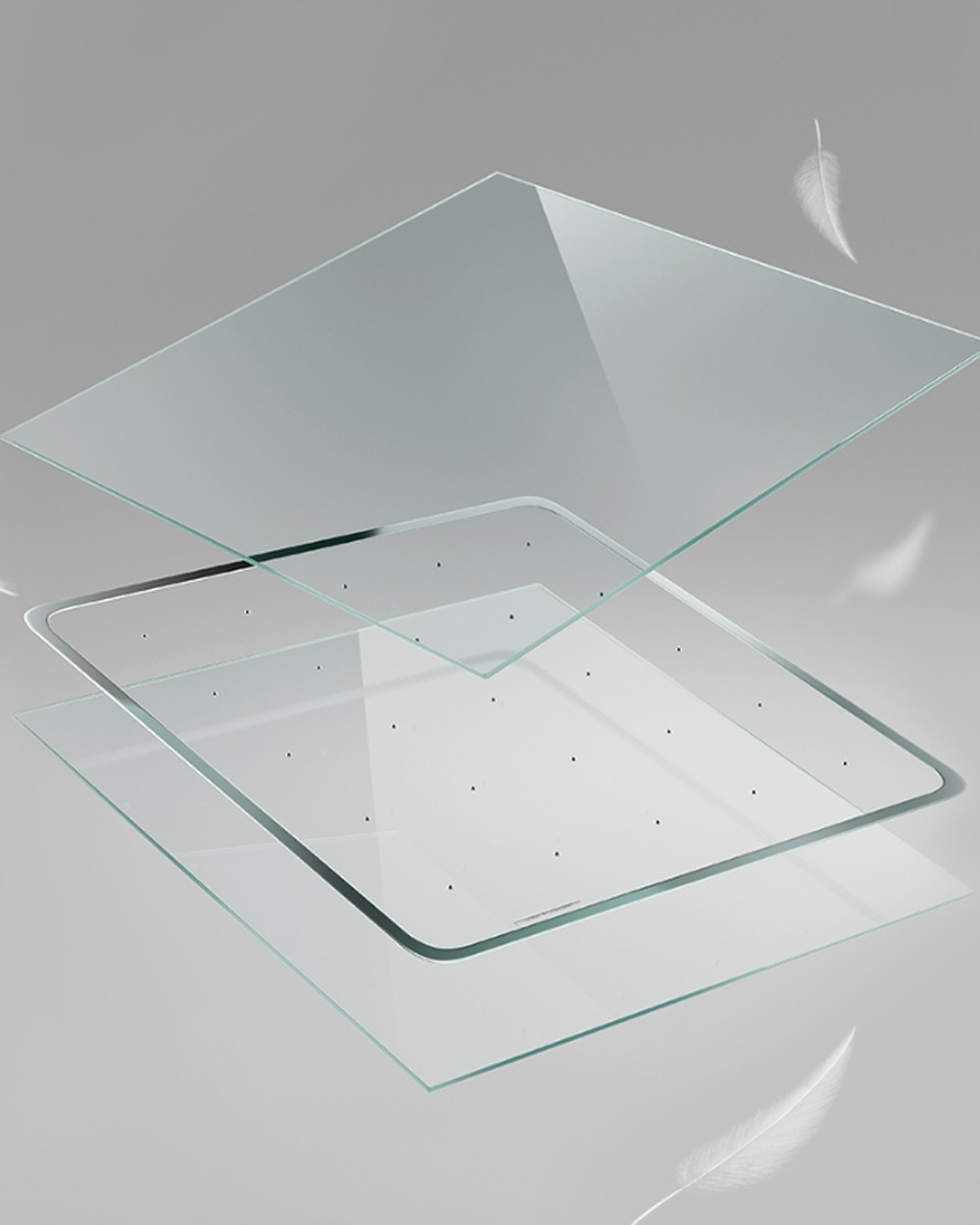
Vacuum insulating glass
A vacuum layer 0.3 mm thick, doing what a 100 mm cavity cannot.
Center-of-glass U-factor
The vacuum unit alone reaches a U-factor near 0.08 Btu/h·ft²·°F (about 0.4 W/m²K) — two to four times better than a conventional argon insulated unit, and six to ten times better than single-pane glass.
Meets Passivhaus alone
At that performance level, a single vacuum unit already meets international passive-house requirements for windows and doors — before it is even paired with the outer argon unit.
Wall performance, glass thickness
Because the vacuum layer is only about 0.3 mm, the whole hybrid unit fits an ordinary glazing pocket. You get wall-level insulation without wall-level thickness.
We never sell a bare vacuum unit. It is always the inner half of a hybrid: an outer argon-filled insulated unit takes the wind load, thermal shock, and surface wear, while the vacuum unit — the more thermally stable, more valuable component — sits in the protected inner position.
Why the vacuum unit sits inside
Three reasons the vacuum unit takes the protected inner position.
Less stress on the edge seal
The outer argon unit absorbs most of the temperature difference between outside and inside. The vacuum unit then sits in a stable, moderated environment, so its edge seal sees far less differential expansion across thousands of thermal cycles.
Titanium alloy edge seal
The vacuum unit's edge is sealed with a flexible, lead-free titanium alloy rather than glass frit. Titanium conducts little heat, tolerates slight movement without cracking, and is sealed below the glass annealing point so the pane keeps its full tempered strength.
A getter keeps the vacuum
A reactive getter inside the sealed cavity chemically locks any stray gas molecules that outgas over time, so the vacuum holds for the life of the unit. No power and no maintenance — it works passively.
The full glazing stack
The hybrid unit in cross-section, exterior to interior. Surfaces are numbered 1 to 6 by the industry-standard convention.
Reading left to right: an outer glass lite, a 14 mm argon cavity, then the vacuum unit — two lites separated by a 0.3 mm vacuum. The 14 mm argon gap is deliberate: argon cavities perform best between roughly 12 and 16 mm. A high-performance thermoplastic warm-edge spacer keeps the perimeter warm and removes the thermal bridge a metal spacer would create.
Climate-specific Low-E strategy
The coating position is tuned to the climate. This is what the ZERO packages carry.
Florida, Texas, Gulf Coast, Caribbean
Rejects incoming solar near-infrared before it enters the cavity, and keeps the warm-edge spacer cool.
Boston, Minneapolis, Canada, Northern Europe
Reflects outgoing interior far-infrared back into the room in winter for maximum heat retention.
Mid-Atlantic, Pacific Northwest, most of Europe
Two independent coatings: Surface 2 blocks summer solar gain, Surface 5 retains winter heat. Different wavelengths, no interference.
More than insulation
The same vacuum layer that stops heat also brings quiet, altitude-proof stability, and a long service life.
Quiet as well as warm
A weighted sound reduction index above 39 dB brings a busy street close to library quiet. The vacuum layer works against both the low-frequency rumble of traffic and the high-frequency edge of construction, noticeably better than a conventional insulated unit.
Works at any angle, any altitude
There is no gas in the vacuum layer to expand or contract, so performance does not change with elevation, geography, or mounting angle. The U-value holds whether the glass is vertical, sloped, or overhead, which suits skylights, sunrooms, and daylighting roofs where sealed gas units struggle.
Built to last
The unit is inorganic, with nothing to off-gas or degrade. A flexible titanium-alloy edge seal absorbs the movement that cracks rigid seals across large indoor-to-outdoor temperature swings, and a built-in getter holds the vacuum for decades. Every unit starts from tempered safety glass and passes multi-stage inspection, so the spontaneous-breakage rate stays comparable to an ordinary insulated unit.